
Last Christmas Tom Coggan was on a ski holiday in Japan with his partner and some old mates from uni when he remembered he needed to move a mob of cattle onto fresh pasture. So, he pulled his phone from his ski jacket.
Coggan wasn’t calling someone back on the farm in Queensland to let the kelpies off the chain. On his phone he has the Halter app, one of several dozen agricultural apps that, for him, have become essential farm management tools. The app linked him to the Halter collars attached to his breeding cows, ruminating in a paddock 400 kilometres west of Brisbane, and some 7000 kilometres south of Japan. “We were skiing at Happo-One [at Hakuba] and we stopped for lunch up on the slopes and I did the movements,” he says.
He reset the boundaries on the virtual fence surrounding his breeders. A vibration on the collar “mustered” the cattle, and got them to walk calmly to where the fresh pasture awaited. And then, a virtual gate closed behind them. They would remain grazing within this invisible fence until it was time for them to be moved again.
There were no dogs and no motorbikes and, after a beef burger and chips washed down with Sapporo, the 27-year-old farmer was back on the chairlift.
It’s farming as not even Orwell could have envisaged.
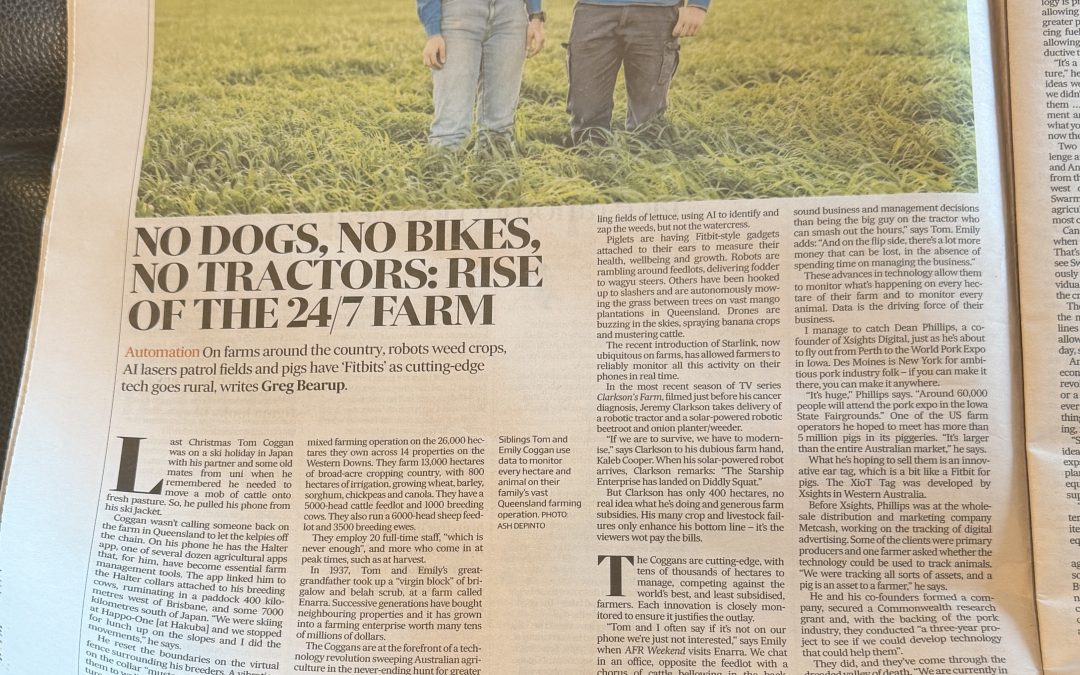
Tom and his sister, Emily, 28, and their parents, Cindy and Phillip Coggan, run a massive mixed farming operation on the 26,000 hectares they own across 14 properties on the Western Downs. They farm 13,000 hectares of broad-acre cropping country, with 800 hectares of irrigation, growing wheat, barley, sorghum, chickpeas and canola. They have a 5000-head cattle feedlot and 1000 breeding cows. They also run a 6000-head sheep feedlot and 3500 breeding ewes.
They employ 20 full-time staff, “which is never enough”, and more who come in at peak times, such as at harvest.
In 1937, Tom and Emily’s great-grandfather took up a “virgin block” of brigalow and belah scrub, at a farm called Enarra. Successive generations have bought neighbouring properties and it has grown into a farming enterprise worth many tens of millions of dollars.
The Coggans are at the forefront of a technology revolution sweeping Australian agriculture in the never-ending hunt for greater productivity and precision.
Two years ago, they were the first beef farmers in Australia to use the Halter collars, which allow them to fence, move and monitor their cattle. Halter, a New Zealand-based tech company started by the son of a dairy farmer, is now valued at $2.9 billion after the tech billionaire, Peter Thiel, recently bought in.
Two reasonably recent developments have supercharged the tech revolution in farming: artificial intelligence and Starlink.
On farms around the country, robots are being used to weed crops, identifying individual weeds and delivering a direct hit of herbicide. Robot-controlled lasers are patrolling fields of lettuce, using AI to identify and zap the weeds, but not the watercress.
Piglets are having Fitbits attached to their ears to measure their health, wellbeing and growth. Robots are rambling around feedlots, delivering fodder to wagyu steers. Others have been hooked up to slashers and are autonomously mowing the grass between trees on vast mango plantations in Queensland. Drones are buzzing in the skies, spraying banana crops and mustering cattle.
The recent introduction of Starlink, now ubiquitous on farms, has allowed farmers to reliably monitor all this activity on their phones in real time (don’t mention Telstra in the bush).
In the most recent season of TV series Clarkson’s Farm, filmed just before his cancer diagnosis, Jeremy takes delivery of a robotic tractor and a solar-powered robotic beetroot and onion planter/weeder.
“If we are to survive, we have to modernise,” says Clarkson to his dubious farm hand, Kaleb Cooper. When his solar-powered robot arrives, Clarkson remarks: “The Starship Enterprise has landed on Diddly Squat.”
But Clarkson has only 400 hectares, no real idea what he’s doing and generous farm subsidies. His many crop and livestock failures only enhance his bottom line – it’s the viewers wot pay the bills.
The Coggans are cutting-edge, with tens of thousands of hectares to manage, competing against the world’s best, and least subsidised, farmers. Each innovation is closely monitored to ensure it justifies the outlay.
“Tom and I often say if it’s not on our phone we’re just not interested,” says Emily when the AFR Weekend visits Enarra. We chat in an office, opposite the feedlot with a chorus of cattle bellowing in the background.
“If we can’t have it on a phone, it means we can’t make decisions in the paddock. If you’re in the paddock and you’ve got a broken-down machine, you should be able to deal with it then and there.”
When their father left school to work on the farm, the measure of a good farmer was how many hours they were prepared to spend on the tractor at planting and harvest.
“When Dad was younger, the doing part was so important,” says Tom.
But farming has changed and the farms that have survived and prospered are now worth tens of millions of dollars.
“There’s more money to be made making sound business and management decisions than being the big guy on the tractor who can smash out the hours,” says Tom.
Emily adds: “And on the flip side, there’s a lot more money that can be lost, in the absence of spending time on managing the business.”
These advances in technology allow them to monitor what’s happening on every hectare of their farm and to monitor every animal. Data is the driving force of their business.
I manage to catch Dean Phillips, a co-founder of Xsights Digital, just as he’s about to fly out from Perth to the World Pork Expo in Iowa. Des Moines is New York for ambitious pork industry folk – if you can make it there, you can make it anywhere.
“It’s huge,” Phillips says. “Around 60,000 people will attend the pork expo in the Iowa State Fairgrounds.” One of the US farm operators he hoped to meet has more than 5 million pigs in its piggeries. “It’s larger than the entire Australian market,” he says.
What he’s hoping to sell them is an innovative ear tag, which is a bit like a Fitbit for pigs. The XioT Tag was developed by Xsights in Western Australia.
Before Xsights, Phillips was at the wholesale distribution and marketing company Metcash, working on the tracking of digital advertising. Some of the clients were primary producers and one farmer asked whether the technology could be used to track animals. “We were tracking all sorts of assets, and a pig is an asset to a farmer,” he says.
He and his co-founders formed a company, secured a Commonwealth research grant and, with the backing of the pork industry, they conducted “a three-year project to see if we could develop technology that could help them”.
They did, and they’ve come through the dreaded valley of death.
“We are currently in the scale-up commercialisation mode,” he says. “We’ve got our technologies deployed in eight countries in our target markets. Over the next 12 months, our aim is to commercialise with as many of those demonstration partners as we can.”
The tags give each animal a unique identification, from piglet to, almost, the pot. It tracks their movement, and can tell whether the pig is eating and drinking. It also takes its temperature. Twelve points of data are relayed by the tags every second to be analysed by AI.
“In these big barns, there can be thousands of pigs and what we are doing is identifying the outliers where we see deviations,” says Phillips.
“We’ll draw attention to a particular pig that is not moving as much, or not going to the feeder or has a high temperature … what we are doing is detecting animals that might have issues and allowing the farmer to deal with it much earlier.”
A red light on the ear tags glows to identify the outliers. The ill animals can then be separated and medicated, and it reduces the prospect of an ailment spreading throughout the herd.
It can also detect when sows are coming on heat, allowing farmers to optimise their breeding programs. It can track the offspring of the sows, identifying the attributes a farmer wants, enabling them to keep the pigs they want as breeders.
“What we are building towards is having an AI platform where a farmer, or an executive, can be sitting in an office, and they can query the data and get answers,” he says. “Rather than getting millions of reports, they’ll be able to get the information they need based on their queries.”
Professor Craig Baillie of the Grains Research and Development Corporation says this combination of AI and new technology is producing rapid advancements. It is allowing farmers “to execute with far greater precision.” It is also drastically reducing fuel and chemical consumption, and allowing labour to be deployed to more productive tasks.
“It’s a very exciting time to be in agriculture,” he says. “Many of these concepts and ideas were around 20 or 30 years ago, but we didn’t have the technology to implement them … the technology is not the impediment any more, it’s the ability to imagine what you can do with that technology that is now the challenge.”
Two people who’ve taken up that challenge are the wife and husband team, Jocie and Andrew Bate. They imagined the future from their farm at Gindie, three hours’ drive west of Rockhampton. Their company, SwarmFarm Robotics, is at the forefront of agricultural robotics, and yet it’s a company most city folk have never heard of.
Can you remember what you thought when you first got an iPhone in your hand? That’s the feeling farmers get when they first see SwarmFarm robots in action, autonomously patrolling vast fields, identifying individual weeds and squirting them, but not the crop, with herbicide.
Then, when the chemical tank is empty, the machine returns to a docking station, lines itself up with a nozzle, and refills, allowing the machine to work 24 hours a day, seven days a week.
Andrew is an agronomist and Jocie an economist. Together, they’re helping to revolutionise farming.
“I’m not an engineer or a software engineer,” says Andrew, “but ever since I was a kid I’ve loved building things in the farm machinery shed – welding, mechanical, electrical. Everything.
“SwarmFarm was really born from an idea that as we bought more farms and expanded, we needed bigger tractors, bigger planters, bigger sprayers, bigger harvesting equipment just to keep up, and, and we supersized everything,” he says.
“But I came to realise that we farmed better when we were smaller, we were definitely better farmers when we used smaller equipment.”
This bigger, heavier equipment was, the agronomist says, hugely damaging to the soil, compacting it deep below the surface. But at the same time, they realised there was new technology on the horizon such as computer vision, artificial intelligence and connectivity “that would allow us to farm in a totally different way”.
And so from their farm shed in Woop Woop Queensland, the Bate family set about building a space-age robot that was much lighter and cheaper than a traditional tractor. “We could see that a revolution in farming practices was on the horizon, and we wanted to be part of it.”
In 2008, the year the iPhone launched in Australia, “but before you could buy a drone in Harvey Norman” and the widespread use of AI was a fantasy, Andrew began researching and studying everything he could about robotics, and writing to scientists at British Aerospace, the CSIRO and the University of Sydney.
Meanwhile, back in his shed, he was building prototypes. The early version was an adaptation of an electric golf buggy. After years of trial and error, and struggle, they released their first commercial robot in 2015.
“We started contract spraying with robots in 2015,” says Andrew. They teamed up with a partner that had computer vision technology on its spray units.
These two technologies were a game changer. The lightweight robot would pull the sprayer, which identified the weeds. It reduced the amount of herbicide needed by more than 90 per cent. They sold their first five machines in 2018.
They now employ 70 staff and the robots are manufactured in Queensland.
“They’re very simple machines,” says Andrew. “We’ve designed them so farmers can fix them.”
The grunt is in the software and the IP. The machines cost a bit over $300,000 each. They’re much cheaper than a conventional tractor and, so far, they’ve sold more than 270. Their robots are partnered with other technologies such as an AI spray rig, a slasher or a planter.
“It’s kind of like the iPhone,” says Jocie. “You can hook up all sorts of different applications to it.”
They’ve also had a couple of successful rounds of capital fundraising, which has brought in $70 million. “But I’ve always believed that success shouldn’t be measured by the amount of money you can raise,” Andrew says. “Success is that farmers are using your stuff, and they are prepared to pay for it.”
He adds: “It’s the perfect time, right now, to be in ag tech. We are a 16-year-old company that has had an amazing journey from the farmgate, in Gindie, Central Queensland, to being one of the leading ag autonomy companies in the world … but it was only a couple of years ago that we all started using AI, and we didn’t have Starlink three years ago.”
The revolution, he says, is gathering steam, and it should allow small and innovative local companies to muscle in on the old established international behemoths, such as John Deere, Case and New Holland, that have dominated the market for decades.
Among the first farmers to buy this groundbreaking technology were the Coggans of Enarra.
“The original decision to buy the two robots was Dad’s,” says Emily, who came back onto the farm a few years ago after working for Deloitte in Brisbane in the consulting division, implementing finance tech systems.
Tom holds a master’s degree in agribusiness. “We are early adopters, but it has to work,” he says. “It’s got to fit the equation, commercially, for us to keep it.”
Emily adds: “There’s a whole conversation around whether it’s better to be the first mover, or to wait and watch others make the mistakes. But what we’ve found, particularly with SwarmFarm and Halter, was that [being among the first] we were involved in the conversation, and we’ve actually shaped how that tech has developed.”
Emily says the SwarmFarm robots allow them to spray the paddocks for weeds exactly when they need to be sprayed. In the olden days, with labour shortages, this task could be overtaken by more pressing jobs, such as harvesting.
“If you miss spraying weeds before a rain event, the weeds have already grown,” she says. “The smaller the plant, the easier it is to kill. It means you don’t have to do the repetitive passes, which means less diesel, less chemical, less maintenance.”
Tom pulls up a bunch of spreadsheets on his computer. He says that when they first got the robots, it was difficult to quantify the benefits. Now, he says, there are no doubts.
They took delivery of their first SwarmFarm robot late in 2021. They were the 32nd and 36th robots off the production line. There were some teething problems when they first got the robots, and they were time-consuming, as someone would have to drive out to the paddock where they were operating, and refill them with chemicals several times a day.
And then, late last year, they took delivery of a new autofill system. When the robot needs more herbicide, it returns to a station and is guided to a nozzle. It stops beneath the nozzle, fills itself up, then returns to the paddock to continue spraying.
When the conditions are right, the robot can run 24-hours a day, seven days a week. It just needs to be refuelled, re-greased and have its cameras cleaned, once a day.
It has increased the area each robot can spray from 45 hectares a day to 84 hectares, a huge jump in productivity. Tom says paddocks sprayed by the robots are also the “cleanest” with the fewest weeds. They’re now also using far less herbicide. Back when the crops were blanket sprayed, they’d spray at a rate of 135 litres (of water and chemical) per hectare. They’re now spraying between 7.45 litres and 17.5 litres per hectare.
This productivity can be monitored from an app on a phone. If there are glitches in the software, technicians from SwarmFarm can offer tech support, remotely.
The Coggans were also early adopters of the Halter electronic fencing, and they take me out into the paddocks to show me the collars in action on the cows.
Tom, of course, pulls out his phone. “Every one of those dots is a cow and the white line is the active fence,” he says, angling the screen. “The blue area is where I am going to send them next.”
But it not only allows the farmers to “fence” their cattle, it allows them to move them regularly and to more efficiently graze their land, taking the cattle to parts of the paddock they may not ordinarily go.
We get out into the paddock, and on one side of an invisible line the cattle have eaten the feed down low. On the other side, there is long grass, untouched by the cows. When Tom adjusts the “fence” they’ll move to the fresh pasture. “So, if I am concerned about an animal, I’ll just check in to see if it’s moved, and it’s OK,” he says.
The data is beamed from the cow to a satellite in space, and then back to his phone, wherever he is on earth.